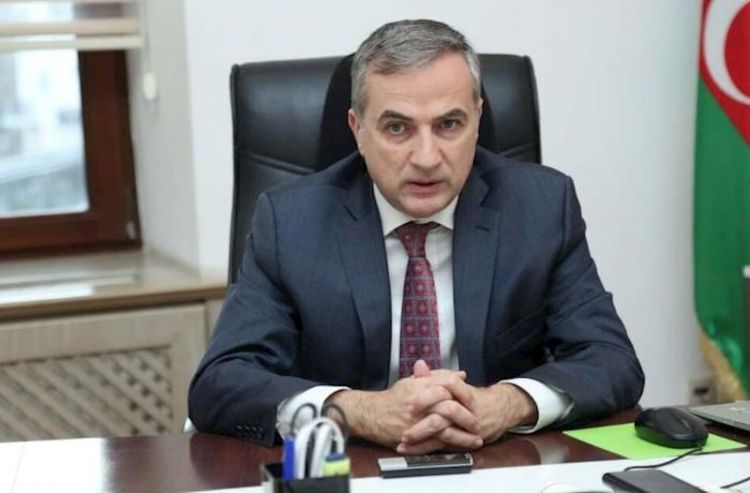
Dr Farid Shafiyev, Chairman of the Center for Analysis of International Relations and Multiculturalism (AIR Center), has addressed a letter to The Guardian regarding its review of The Black Garden, a documentary directed by an Armenian filmmaker.
In his letter, Dr Shafiyev expresses concern over the review’s false and one-sided portrayal of the Armenia-Azerbaijan conflict and argues that the article fails to provide essential historical and political context concerning the occupation of Azerbaijani territories, the displacement of the Azerbaijani population, and the relevant United Nations Security Council resolutions.
The full text of the letter is provided below:
Dear Madam/Sir,
I am writing with regard to the article "The Black Garden review - haunting study of growing up in war-torn Nagorno-Karabakh."
The Guardian’s review of The Black Garden, a documentary directed by an Armenian filmmaker, presents a strikingly biased framing of the former Armenia-Azerbaijan conflict and, as such, goes considerably beyond discussing the film itself. In just a few sentences, it reproduces a deeply one-sided political narrative that effectively casts Azerbaijan – an internationally recognized state whose territories were occupied by Armenia for almost three decades – as the aggressor, while presenting the Armenian side almost exclusively through the prism of victimhood.
The most revealing example is the statement that, after the collapse of the Soviet Union, the “largely Armenian population” of the Karabakh region of Azerbaijan “fought against countless military campaigns from the Azerbaijani army.” This formulation fundamentally distorts the history of the conflict. It creates the impression that Azerbaijan was engaged in a campaign of aggression against an otherwise peaceful Armenian population, while omitting the central fact that the Armed Forces of Armenia instrumentalized the local Armenian population of the
Karabakh region for its aggression and occupation plans, occupied Karabakh and seven surrounding districts of Azerbaijan and ethnically cleansed the occupied territories in the early 1990s.
This is not simply a matter of competing interpretations of history. Four UN Security Council resolutions adopted in 1993 demanded the withdrawal of occupying forces from Azerbaijani territory and reaffirmed Azerbaijan’s sovereignty and territorial integrity. For nearly three decades, up to 700,000 Azerbaijanis were forcibly displaced from their homes in Karabakh and the surrounding districts and denied the right to return. Thousands of civilians were brutally killed, tortured, and taken hostage as part of this violent ethnic cleansing campaign. The occupation was accompanied not only by the expulsion of Azerbaijan’s population, but also by the systematic destruction and looting of entire towns and villages. Large urban centres such as Aghdam were left almost completely devastated, earning the city the description of the “Hiroshima of the Caucasus.” This scale of violence and destruction is conspicuously absent from the Guardian’s account.
Yet none of this Azerbaijani experience is reflected in the Guardian’s framing. Instead, the reader is given a story in which Armenian civilians are victims of Azerbaijani military campaigns, while the Azerbaijani population that was expelled from these territories effectively disappears from the narrative.
The same problem appears in the description of the Talish village. The review opens with the image of a “bombed-out school” and immediately places it within a narrative of Armenian children growing up under Azerbaijani military attacks. But Talish was located on the Line of Contact and was repeatedly affected by fighting. Presenting the destruction without explaining the military and political context allows the image of devastation to function as an accusation against Azerbaijan without establishing who caused the particular damage or under what
circumstances.
The Guardian’s selective framing should also be viewed against a broader political and information campaign aimed at preserving the traditional Armenian narrative of the former conflict and portraying Azerbaijan exclusively as an aggressor. The film was produced through the initiative and sponsorship of those circles who never reconciled with the loss of Karabakh and its liberation by the region's legal owners.
This campaign is supported and amplified by influential Armenian diaspora organizations and lobbying networks, as well as by political and advocacy circles associated with oligarchs such as Samvel Karapetyan and Ruben Vardanyan. Their campaigns are not merely about defending a historical interpretation; they serve the political objective of resisting the normalization of Armenia-Azerbaijan relations and keeping the Karabakh issue alive as a source of political mobilization.
This is particularly damaging at a moment when Armenia’s government is pursuing a fundamentally different course. Prime Minister Nikol Pashinyan has made peace and normalization with Azerbaijan central to his political agenda. Pro-Russian political forces led by Samvel Karapetyan emerged in 2026 as Pashinyan’s principal political challenger, with his "Strong Armenia" movement opposing key elements of Pashinyan’s peace-oriented and Western-facing agenda.
At precisely this moment, narratives that reproduce the old conflict’s Armenian-made binary logic – Armenian victims versus Azerbaijani aggressors – are not politically neutral. They strengthen forces opposing normalization, reinforce the portrayal of Pashinyan’s peace policy as betrayal, and make compromise more difficult.
The Guardian’s own reviewer acknowledges that The Black Garden “could have been enriched by more detailed sociopolitical context.” That is precisely the problem. Describing Armenians as having fought “against” Azerbaijani military campaigns, without explaining the occupation of Azerbaijani territory, the displacement of its population and the UN Security Council resolutions demanding the withdrawal of occupying forces, is not balanced reporting.
Sincerely,
Dr Farid Shafiyev
Chairman, Ambassador
Center for Analysis of International Relations and Multiculturalism (AIR Center) Guardian, August 31, 2026, “The Black Garden review – haunting study of growing up in war-torn Nagorno-Karabakh”. https://www.theguardian.com/film/2026/aug/31/the-black-garden-review-haunting-study-of-growing-up-in-war-torn-nagorno-karabakh

 NTV canlı
 Radio canlı
 Nuhçıxan